Our day is comprised of academic challenge and opportunities for personal growth. Learning across the curriculum includes personalized instruction and content based on each student’s abilities and readiness. Students work as a whole group, in small groups, and individually. The students develop an ability to resourceful, intrinsically-motivated students who care about learning and doing thorough work.
In addition, the program places a major focus on developing social skills and problem-solving. Each day presents opportunities to share feelings and concerns, to discuss social and academic problems, and to nurture and care for each other. The program also teaches children to respect others’ thoughts and feelings, talk through problems, and come to a mutually agreeable resolution when conflict arises.
Language Arts
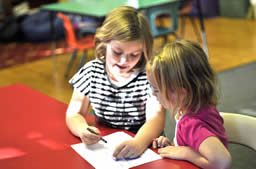
Speaking, listening, reading, and writing are closely interrelated and dependent on each other. The lower elementary program builds on the acquired knowledge of each child as the foundation for beginning reading and writing. The program bridges the gap between reading and writing through invented spelling, building the students’ skill with written fluency and reading decoding.
Writing is a daily activity. Children learn to produce, edit, collaborate, and publish their own work with peer and adult consultation. Many kinds of writing are done, including picture stories, daily journals, informational reports, and letter writing. A sustained reading experience is a daily activity. Each student reads silently, with classmates, and with the whole class and with the teacher. Guidance in selection of appropriate reading material is given as needed, as students become more self-aware. As students excel in their reading and writing, they are encouraged to reach their full potential. A student would never be slowed down or rushed in an effort to keep all students at the same level. Excellence, exploration, and progress all blend with a modeled love of learning that is contagious and exciting in the classroom.
Reading
The reading program includes:
Phonemic awareness
- Phonics activities
- Vocabulary building
- Oral reading
- Silent reading
- Sight word lists
- Drama/performing
- Comprehension skills
- Decoding
- Patterns, rhythm
- Reading comprehension
Writing
The writing program emphasizes:
- Writing complete sentences
- The writing process
- Daily oral language
- Details
- Revising/editing
- Capitalization
- Letter writing
- Punctuation
- Fictional stories
- Factual reports
- Dictionary skills
- Correct grammar
- Quotation
- Correct Spelling
Oral Language
The oral language program focuses on:
- Speaking clearly
- Sharing thoughts and feelings
- Sharing information in complete sentences
Math
Manipulatives and math games are used to increase an understanding of mathematical operations and concepts. Students proceed at their own pace. Students who are ready to work above grade level do so.
Math is also used as a tool for the study and observation of other topics being investigated. Curriculum areas include:
- Even and odd numbers
- Addition
- Subtraction
- Borrowing with subtraction
- Carrying with addition
- Money
- Time
- Fractions
- Reading and writing large numbers
- Story problems
- Graphing
- Measurement
- Beginning concepts of division and multiplication
- Place value
- Estimating
- Number writing
- Problem-solving
- Geometric shapes
Theme Studies
Overreaching themes are often used to integrate all areas of the curriculum. This is the main way that science and social studies are approached in the lower elementary classroom. Themes vary from year to year but take in account student interests. The themes offer opportunity for a variety of approaches in all subject matters. Theme studies provide opportunity for individual, small group, and total class activities and are ideal for coordinating music, art, and current events with the expected reading, math, science, and social studies.
Themes have included:
- Insects
- Ocean life
- Energy
- Community
- Maps
- Nutrition and well-being
Projects
The project topics are chosen according to student interests and academic standards. Students do research for their projects with: Reading, exploring the internet, interviewing experts, watching informational DVDs, and field trips. Students produce work that includes many cross-curricular elements such as listening, speaking, reading, writing, drama, math, science, and social studies.
Technology
Technology is used in the classroom every day. Students are able to use the computers to learn how to type and play literacy and math games. A video cassette recorder, television, and overhead projector are used for some activities in the classroom.
Science
The lower elementary curriculum uses science to explore nature and the world around us. Children learn to explore, observe, count, collect, measure, compare, and ask questions about their world. Field trips are an important part of this process. Children engage in:
- Experimentation
- Prediction
- Observation
- Cooking
- Classification
- Interpreting data
- Collecting data
Social Studies
The social studies curriculum focuses on allowing children to experience and understand various cultures. It also helps them to experience the diversity of their community, city, state, and world. This is done through:
- Field trips
- Multi-cultural stories
- Guest speakers
- Art experiences
- Music and dance
- Maps skills
- Games
- Location of continents and oceans
- Current events
- Readings
- Food
The Arts
In the lower elementary classroom children are encouraged to express their creativity through many different art experiences. A large array of art supplies is always available to the students. We also study art and artists to compare styles, use of color, and form. The students learn that art is a form of self-expression and everyone’s art should be appreciated and encouraged.
The arts program emphasizes::
- Painting
- Drawing
- Sculpture and models
- Collage
- Color wheel
- Individuality
Music
Our music instructor works with the class once a week for 30 minutes. The goal of music is to let children experience many different types of music and help them feel good about performing and singing in front of others. Activities include:
- Listening to songs from many areas of the world
- Making rhythm instruments
- Exploring dance with music
- Writing simple songs
- Performing for large groups
Performances
Children perform through:
- Plays
- Puppet shows
- Oral readings
- Project presentations
Spanish
Our Spanish instructor works with the class twice a week for thirty minutes. Children are exposed to:
- Counting
- Greetings
- Stories
- Food
- Culture
- Songs
- Animals
- Simple conversation
- The natural sounds and rhythms of Spanish
- Color words
- Body parts
- Clothing
- Shapes
- Family
- Writing
- Spanish alphabet
- Pronounciation
Social and Emotional Development
The social and emotional growth of each student is approached with the same concern as the academic growth; it is a part of every aspect of the curriculum. The primary goal is to help every student be confident in his or her own abilities and be able to resolve conflict peacefully. The goals are to:
- Develop responsibility for one’s actions and learning
- Gain self-control
- Respect others
- Cooperate with others
- Express thoughts and feelings in an appropriate manner
- Be able to resolve conflicts positively
- Make good decisions and follow through with them
- Be honest
- Act with integrity
Physical Development
There are many opportunities for daily physical activity. Health, nutrition, and care for our bodies are taught. Activities include:
- Running
- Jumping
- Skills with balls
- Stretching
- Outdoor play
- Walking
- Cooperative games
- Balance
- Skipping
Assessment
Assessment is done between teacher and child, parent and teacher, student to student, and overall teacher assessment. It is an important part of the learning process, and each student is assessed based on his/her growth throughout the school year. We have an evaluation of student progress twice a year, two parent/teacher conferences, and portfolios of student work. Communication between teachers and students is an important part of all aspects of student learning and progress.
 "When we place nature at the center of our community, we come to realize the true abundance of the world we live in. This school puts these seeds of hope in its students; it changes how they move through the world, and it changes the communities they enter for the better.”